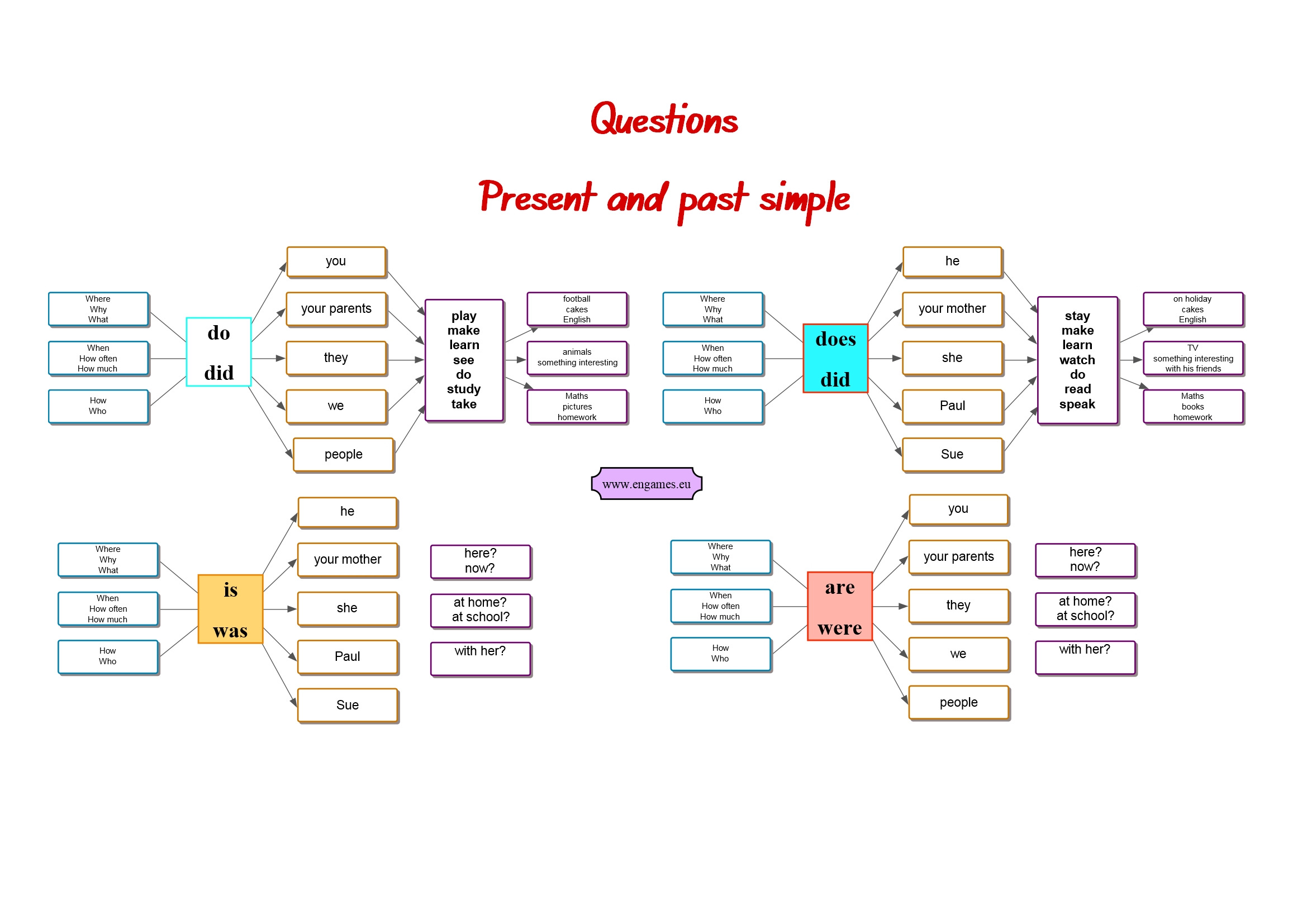
The word LIKE is one of the most productive words in English. However, many students often confuse the meaning of the questions with LIKE and they give completely wrong answers. Especially pre-intermediate students of English find these questions really difficult. ADVERT:
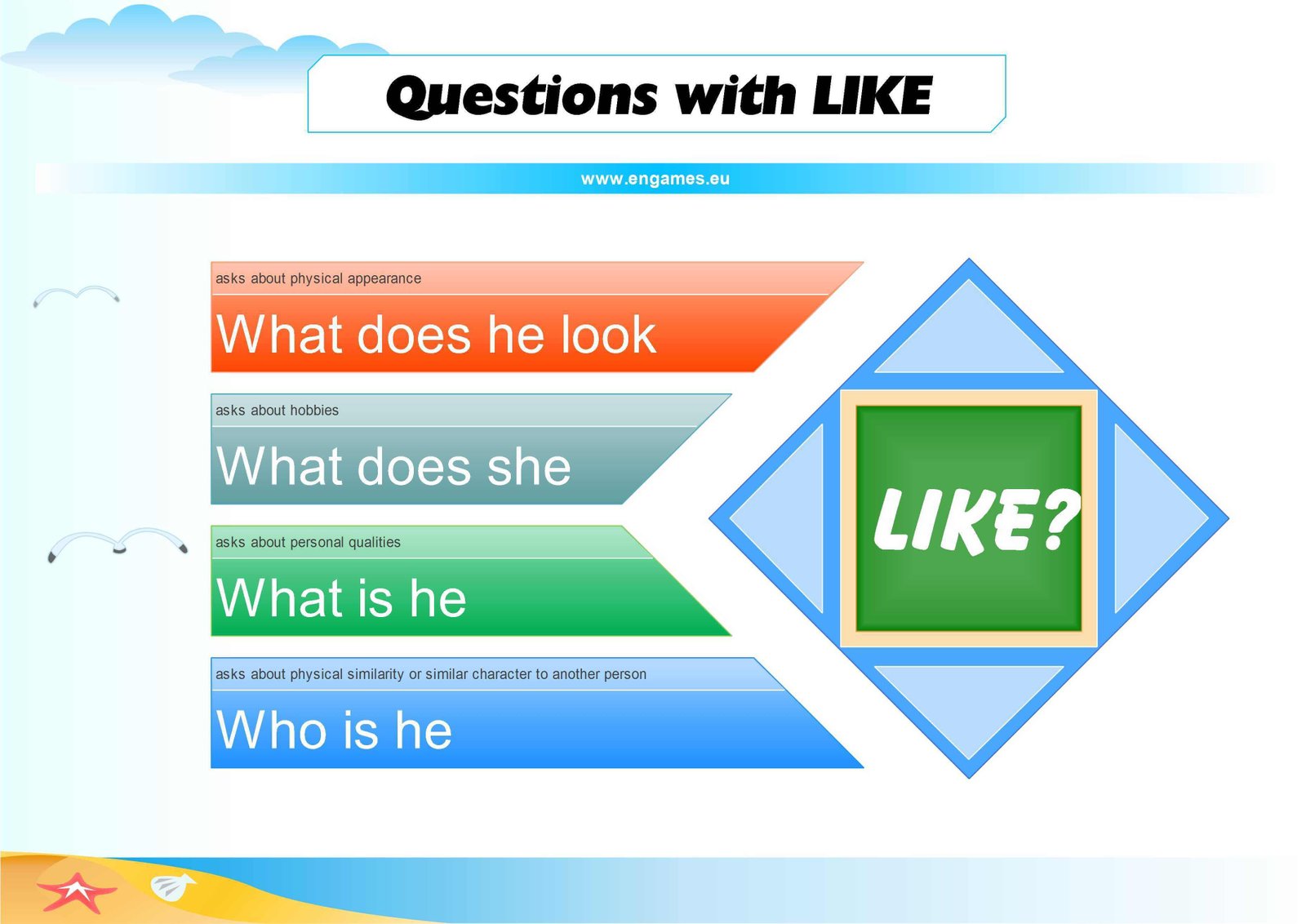
The aim of this post is to explain the meaning of different questions with LIKE and give students a chance to practise and remember the questions. To achieve this there is a video which is based on BBC programme called Grammar Challenge. Moreover, there is an infographic and a quiz to practise the grammar.
Questions – video explanation
When I asked my brother what he does on the Internet he told me that he spends most time watching videos. And in my experience that is true for most of teenagers. To attract them to learning English I decided to create a short video explanation based on BBC learning English programme called Grammar Challenge. Watch the video and try to understand the grammar.
Once your students have watched the video, you can hand out the following infographic. Go through the sentences and elicit the correct answers to the questions in the picture.
Questions with like – online quiz
The following quiz consists of two parts. In the first part students listen to the answer and they have to choose the correct question. In the second part, students see the answer and part of the question and they have to type in the missing words to make the question correct. If the students pass the tests they will be rewarded with a game.
The quiz is in HTML5 and it will work on the desktop and all mobile devices.
Recently, in the post called Questions with Like, I asked you to choose the activity you would like me to write about. Most of you voted for a Speaking activity, so I prepared a set of speaking activities to practice the prepositions of place.
I have already created a post on prepositions, so this time there will be no infographics just two speaking activities. If you are looking for more speaking activities, you can find a two great speaking activities here. ADVERT:
Speaking activities – Battle
The first activity is called Battle and it was devised and recommended by K. Folse in his book The Art of Teaching Speaking.
First, print out the worksheet with 18 pictures. Each picture is different and they are labelled with letters A to R.
Ask students to work in groups of three. They should label themselves A, B, and C. Student A starts. Student A will choose a room in the worksheet. Then students B and C will take turns asking yes – no questions to identify A´s room. For example, B asks: “Is the table in front of the sofa?” If student A answers “Yes, it is,” student B asks another question. He continues in this way till student B answers “No.” Then it is student´s C turn. Students go on like this till someone identifies the picture student A is thinking of.
After student B or C has guessed A´s room, student B chooses a room and students A and C try to guess it in the same way as they did with student A.
Students keep track of how many rooms they guessed correctly, and the winner is the one who guessed most.
Here is the worksheet students will use (it is enough to print out just one worksheet for each group.)
Speaking activities – Language needed
To be able to do the task above successfully, your students need to know the following vocabulary and grammar:
Vocabulary: plant, picture, lamp, table, cushion, plant, sofa, floor, wall, chair, ball and the prepositions of place (you find the materials to teach Prepositions of place here). Grammar: to form question with is/are and the phrases There is / there are.
If your students do not know the language mentioned above, the speaking activity will not work!!!
Speaking activities – Drawing a Picture
First you need to print out the following worksheet once for each pair of students. They should cut it in the middle and each student should keep one sheet. (Now each student has two pictures with the room.)
Then, each student draws between 5 and 10 objects into one of his pictures. He or she has to draw objects they know the English words for. I personally ask my students to draw pieces of furniture we learn in the textbook unit.
Students sit with their backs to each other and one describes their picture for their partner, and the partners draws the objects into the picture he or she has not drawn into yet. When one student finishes they swap their roles and the other student describes their picture.
The third conditional is the most feared grammar point I know. Students of English think that it’s hard to form and understand. Therefore, when they start learning the grammar they are paralysed with fear. And as a result, they fail to learn it. Thus the third conditional keeps its reputation. ADVERT:
But the truth is that the third conditional is not difficult at all. In this post I will show you how to teach this grammar quickly. I hope to destroy the myth that the third conditional is difficult.
Third conditional – song
Start the lesson with the following song:
Here is a short worksheet that will help you introduce the grammar:
Next, explain the meaning of the third conditional. Tell your students that the if-clause of the conditional speaks about a situation in the past that did not happen. The second part of the sentence expresses our hypothesis about what could have happened if the first part of the sentence were true. In both parts we speak about the past, and none of the actions happened. The ideas expressed in the third conditional are about the past and they never happened.
Now, ask your students to form three third conditional sentences using the clues in the infographic and to describe the situations in which they might be used. For example: Martina went to a party yesterday. She got drunk and the police arrested her. If she had stayed at home, nothing of this would have happened. ADVERT:
Third conditional – quiz
The following quiz can help your students practise the third conditionaleither at school or at home. The quiz consists of two parts. In the first part, students should match the beginnings and ends of the third conditional sentences. In the second part, students have to put the verbs into the correct form to form the third conditionals. The students will be rewarded with a game after each part of the quiz they pass. The quiz is in HTML5, so it will play on all desktops and mobile devices.
When I saw the news about Eva Carneiro vs Mourinho I realised it may be a great material for my teenage classes. Many boys love football, and many girls like helping others and all of them feel strongly about justice. This explosive mixture should lead to a great discussion in class. That´s why I decided to use the news about Mourinho firing the doctor Eva Carneiro from Chelsea bench to create the following worksheet. ADVERT:
The first activity is the classical Find Someone Who speaking activity. Hand out the worksheet (best print it on both sides of one page) and ask your students to form questions they will ask their partners. You might drill some of the more difficult questions with the whole class.
Explain that the students can have just one name next to each statement and I always stipulate that students must write the name of each student only once into their worksheet.
Ask the students to stand up and mingle and complete their worksheet.
Stop the activity after five minutes and elicit who does what.
Eva Carneiro vs Mourinho – vocabulary
In the worksheet there are two vocabulary activities. The first one is called New Vocabulary and students should study the words here. If you teach a monolingual class you can ask them to translate the words.
The second activity is called Remembering Tables. Ask the students to have a look at the first table on the left. Read the words aloud and students have to repeat them. Then give the students 20 seconds to remember all the words. After the set time, students cover the table on the left and write the words into the first table on the right. After they finish they check their answers and spelling.
Do the same with the second, third and fourth table, but the time given should be 30,45 and 30 seconds.
Eva Carneiro vs Mourinho – Reading and speaking
The third activity is called Reading and it is the most traditional activity you will find here. Students read the text and answer the comprehension questions in the part called Answer the Questions.
Once you check the students’ comprehension of the text, move to the fourth activity, which is speaking again. Students work in pairs. One of them pretends to be a reporter and the other is Eva Carneiro. The reporter asks the questions in the Role Play exercise and the other students tries to answer as Eva would.
When they finish, students swap roles and the student who was Eva is the reporter now and the other student pretends to be Jose Mourinho now. The reporter asks the same questions but the other student has to try to answer them as Jose Mourinho would.
You can then change the pairs and repeat the activity once or twice.
Eva Carneiro vs Mourinho – Grammar up
Here I start with a rather strange drill. I ask the students to put the worksheets away and I read the sentences from the text and the students have to repeat them. I do not correct them I just leave them repeat the sentence they heard as best as they can. ADVERT:
The last activity is called Grammar Up and students have to complete the last text with the missing words without looking into the original text. Once they finish they should check their answers with the original text in the section Reading.
Eva Carneiro vs Mourinho – Conclusion
I hope that your students will find the text Eva Carneiro vs Mourinho so interesting that they will discuss it in full. Please leave your comments to tell me how well or badly the activity went in your class. I will read your comments carefully and try to improve the activity.
A few days ago my friend Shanthi Cumaraswamy Streat publised a great post called “20 Phrasal Verbs with ‘BRING’ – Let’s Explore“. I liked it so much that I contacted Shanthi and she kindly agreed to my turning her post into infographics and games. And here you can see the final result of our great cooperation.
ADVERT:
Phrasal verbs with BRING – infographics
On her blog http://englishwithatwist.com/ Shanthi comes up with twenty different meanings of the phrasal verbs with BRING. Here, we tried to put the information in two infographics (as it was not possible to put all the information into just one ).
Once the students study the infographics, it is time to practise their knowledge. I created 3 games to help them with the revision.
The first game is called On Target. Students should read the sentence and complete it with the correct option A-D. If they answer correctly, they are given a chance to shoot the bad ducks. They can shoot one of the bottles on the sides and get a bonus. This game is in Flash and it will play only on desktops.
The second game is called Penalty Shoot Out. At school students love playing in two teams against each other. They have to choose the correct answer and then they should score a goal. It is not easy but it is great fun. This game is in Flash and it will play only on desktops.
The third game is called Goose Science Quiz and the students click on the die and move forward. From time to time they have to answer a question. If they answer correctly they move forward and if they answer incorrectly they move backwards. The winner is the student who gets to the FINISH first. The game is in HTML5 and it will play on all electronic devices.


 12:28
12:28